-
Products
-
![]() Storage & Logistics Equipment
Storage & Logistics Equipment
- All Products
-
Featured Products
Featured Products
- Used Products
-
![]() Racking & Storage Systems
Racking & Storage Systems
- All Storage Systems
- Racking Inspections and Repairs
- Safety, Process & Maintenance
- Warehouse Transfer Rentals
-
![]() Rental Equipment
Rental Equipment
- Equipment To Rent
-
![]() Manufacturing
Manufacturing
- Plastic Box Manufacturing
- Roll Pallet Manufacturing
- Stillages Manufacturing
-
![]() End-to-End Service
End-to-End Service
- The Full Product & Service Offering
-
- Rental
- Industries
- About
- News & Insights
- FAQs

















Collaborative Robots in Warehousing: When Humans and Robots Work Together
- Blog
- Storage Solutions
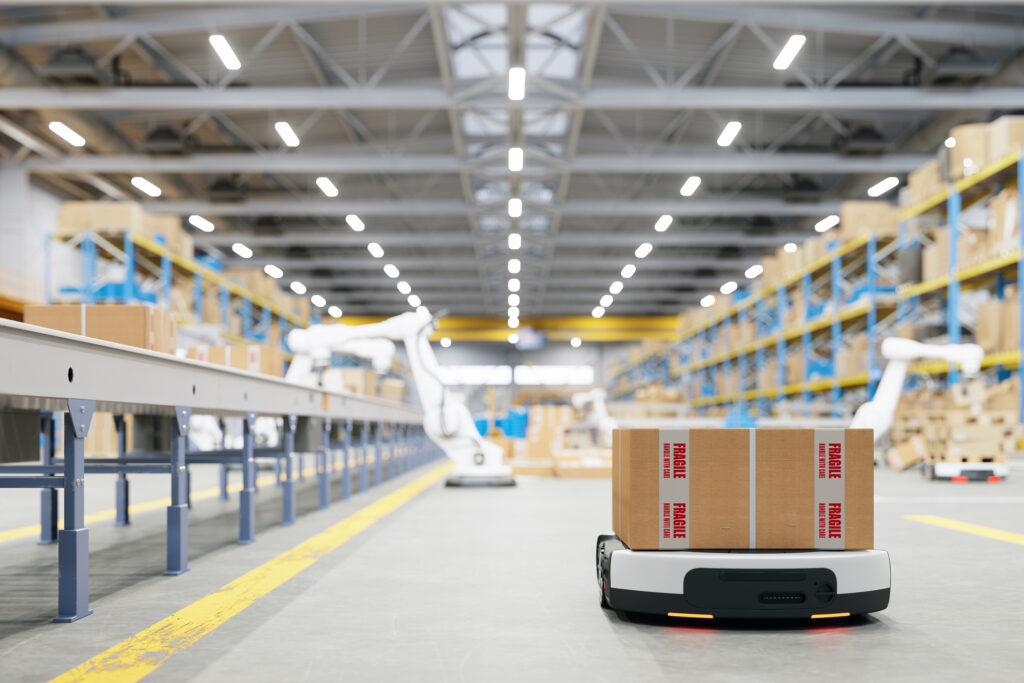
In the next two to three years, food retailer Ocado expects robots to handle around 70% of its products. This isn’t an isolated story, with businesses across the UK looking for smarter ways to manage storage, cut costs, and keep workers safe.
One of the most effective solutions is the use of collaborative robots (or cobots), which are designed to work alongside human teams to improve productivity and safety on the warehouse floor. If you’re considering implementing cobots in your workspace, below we discuss the key things to know, including what they are, how they work, their impact, and the different types available.
What are collaborative robots?
Collaborative robots are a type of robotic system designed to work directly alongside humans on the warehouse floor.
Where traditional industrial robots operate in isolation, cobots share the same workspace as your team. They’re built to assist with repetitive, complex, or hazardous tasks, whether that’s lifting heavy loads, picking orders, or moving goods between stations.
Cobots protect both your workers and your products. They reduce the physical strain on staff and bring a level of accuracy and consistency that’s difficult to match by hand. Businesses of all sizes, from small distribution centres to large fulfilment operations, use them to improve productivity without increasing headcount.
How do collaborative robots work with humans?
Cobots are purpose-built for shared workspaces. They handle repetitive, predictable tasks with high accuracy, which frees up your team to focus on work that needs judgement, problem-solving, and skill.
One of the features that makes cobots so practical is how easy they are to programme. Workers can “teach” a cobot a new task by physically guiding its arm through the motion. The robot learns the movement and repeats it on command, with no specialist programming knowledge needed. This makes cobots far more flexible than traditional automation.
Safety is also built into every aspect of cobot design. Sensors allow them to detect nearby workers and adjust their behaviour accordingly, slowing down or pausing when someone gets too close. If contact does occur, cobots are designed to minimise the risk of injury through force limitations, rounded edges, and collision detection systems.
Impact of collaborative robots in warehousing
Here’s what they can bring to warehouse operations:
- They speed up order fulfilment and reduce bottlenecks at every stage of the process.
- They reduce reliance on manual, repetitive labour and improve output per worker.
- They reduce the risk of manual handling injuries by taking on physically demanding work.
- They minimise human error, particularly in picking, packing, and palletising tasks.
- They can support extended operating hours with minimal downtime when properly maintained.
- They protect fragile goods from damage and shield workers from hazardous inventory.
Types of collaborative robots
Not all cobots work in the same way. There are four main types, each suited to different environments and levels of human interaction.
Safety monitored stop cobots
These are designed for applications where interaction between humans and robots is minimal. They typically use an industrial robot fitted with sensors that stop operation whenever a worker enters the robot’s working area. They’re well suited to tasks where humans need occasional access but don’t work continuously alongside the machine.
Speed and separation monitoring
Speed and separation cobots take a more dynamic approach. Using advanced vision systems, they monitor the distance between the robot and nearby workers in real time. As a worker gets closer, the robot slows down. If a worker gets too close, it stops completely. This makes them a good fit for environments where workers move around more freely.
Power and force limiting cobots
Power and force limiting cobots are the most common type you’ll find in modern warehouses. Built with rounded edges and intelligent collision sensors, they detect contact with a human instantly and stop. Force limits are set to ensure that even if a collision does happen, the risk of injury is very low.
Hand guiding cobots
Hand guiding cobots give operators direct control during operation. A hand-guided device lets the worker control the robot’s movements in real time, which is particularly useful for tasks like supporting the weight of a heavy component while the operator positions it precisely. This capability also helps with programming: workers can guide the arm through a sequence of movements to teach the cobot a new task.
Collaborative robots in warehousing applications
Cobots are already at work across a wide range of warehousing tasks. Here’s how they help in practice.
Order picking
Order picking can account for a significant proportion of warehouse operating costs (often cited at up to 70%). Cobots help by integrating with vision systems and warehouse software to identify and retrieve items, speeding up the picking process, cutting errors, and improving the accuracy of customer orders.
Sorting and categorising
Sorting happens at multiple points in the warehouse journey, from goods-in through to dispatch. Cobots sort items based on predefined criteria such as size, weight, or shipping destination, which is especially useful in high-volume operations handling a wide mix of products.
They integrate smoothly with both automated and manual sortation systems, keeping operations flexible.
Picking and placing
Pick and place cobots are designed to move items from one point to another with precision and speed. They’re used in assembly, packaging, and selective picking applications. Many are fitted with vision systems that can inspect products on a moving conveyor, identify defects, and remove them automatically. This reduces errors and handles goods carefully at every stage.
Packing and packaging
Cobots are highly effective at packing items into boxes, optimising how space is used, and making sure products are secured properly before they leave the warehouse. They can also manage labelling and sealing, automating the full packing process. The result is typically consistent packaging, less damage in transit, and faster dispatch preparation.
Palletising and depalletising
Stacking and unstacking pallets is physically demanding and prone to error. Cobots handle this with high precision and repeatability, stacking loads securely, using warehouse space efficiently, and reducing the manual handling that puts workers at risk.
Autonomous mobile robots (AMRs)
Autonomous mobile robots (AMRs) are increasingly used to transport goods within warehouses, from goods-in through to shipping docks. They navigate autonomously, avoid obstacles, and work safely alongside people. Whether you run a single unit or a fleet, they automate internal logistics and reduce the need for manual transport tasks.
Inventory management
Cobots equipped with sensors and cameras perform regular stock counts and update inventory records in real time. This reduces discrepancies, improves stock accuracy, and keeps operations running smoothly without tying up staff in manual counting tasks.
Returns processing
For e-commerce and 3PL operations, returns are a major operational challenge. Cobots sort and inspect returned items, assess their condition, and route them appropriately for restocking or disposal. This cuts processing time and helps resolve customer issues faster.
Safety and maintenance tasks
Cobots fitted with inspection tools carry out routine checks and maintenance tasks, minimising the need for workers to access hazardous areas. This proactive approach keeps equipment in good condition, reduces downtime, and improves overall warehouse safety.
Considerations of collaborative robots in warehousing
Introducing cobots into your warehouse comes with a few important things to think through before you get started.
System integration is the first challenge. Your cobots need to work with your existing warehouse management system, conveyors, racking, and workflows. Getting this right from the outset saves a lot of time and disruption further down the line.
Workforce training is just as important as the technology itself. Your team needs to feel confident working alongside cobots, understanding what they do, how they behave, and how to interact with them safely. A phased introduction and clear communication make the transition much smoother.
Scalability is one of the strong suits of most modern cobot systems. As your operation grows or your needs change, you can add units, reprogramme tasks, or redeploy cobots to new areas. It’s worth choosing systems that are designed with this flexibility in mind from the start.
Differences between collaborative robots and traditional robots
The key difference between cobots and traditional industrial robots comes down to how they’re designed to interact with people.
Traditional robots are faster and more powerful, but they need physical separation from workers, usually in the form of safety cages or exclusion zones. They’re built for high-speed, high-volume tasks in fixed environments where human contact is eliminated entirely. Cobots are built to do the opposite. They’re designed for direct, safe interaction with people. They’re not as fast as industrial robots, but they’re far more flexible and practical in shared workspaces. For most warehousing applications where humans and automation need to work side by side, cobots are the better fit.
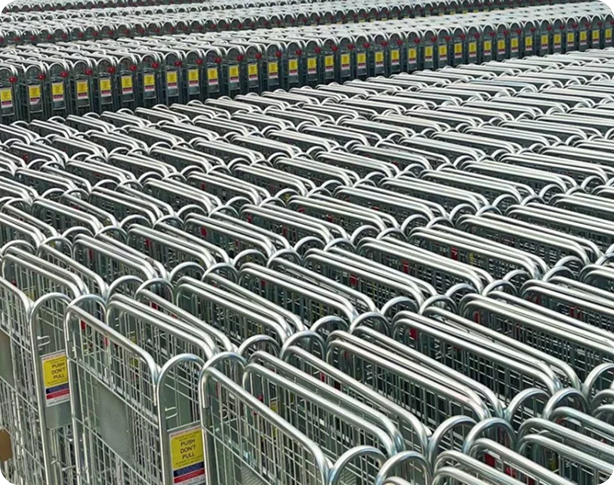
Get roll pallets for robotic and automated warehousing from Palletower
Collaborative robots are changing the way warehouses operate across the UK. From order picking and packing through to palletising and material handling, cobots help teams work more efficiently, more safely, and more consistently. To get the most from your cobot setup, you need storage solutions built to work with automated systems.
Palletower supplies roll pallets for automated warehousing designed to integrate with robotic and automated workflows, helping you get the best performance from your warehouse operation. Browse the range or get in touch with the team to find the right solution for your operation.