-
Products
-
![]() Storage & Logistics Equipment
Storage & Logistics Equipment
- All Products
-
Featured Products
Featured Products
- Used Products
-
![]() Racking & Storage Systems
Racking & Storage Systems
- All Storage Systems
- Racking Inspections and Repairs
- Safety, Process & Maintenance
- Warehouse Transfer Rentals
-
![]() Rental Equipment
Rental Equipment
- Equipment To Rent
-
![]() Manufacturing
Manufacturing
- Plastic Box Manufacturing
- Roll Pallet Manufacturing
- Stillages Manufacturing
-
![]() End-to-End Service
End-to-End Service
- The Full Product & Service Offering
-
- Rental
- Industries
- About
- News & Insights
- FAQs














What Are Retention Units and When Do You Need Them?
- Cage Pallets
- Storage Solutions
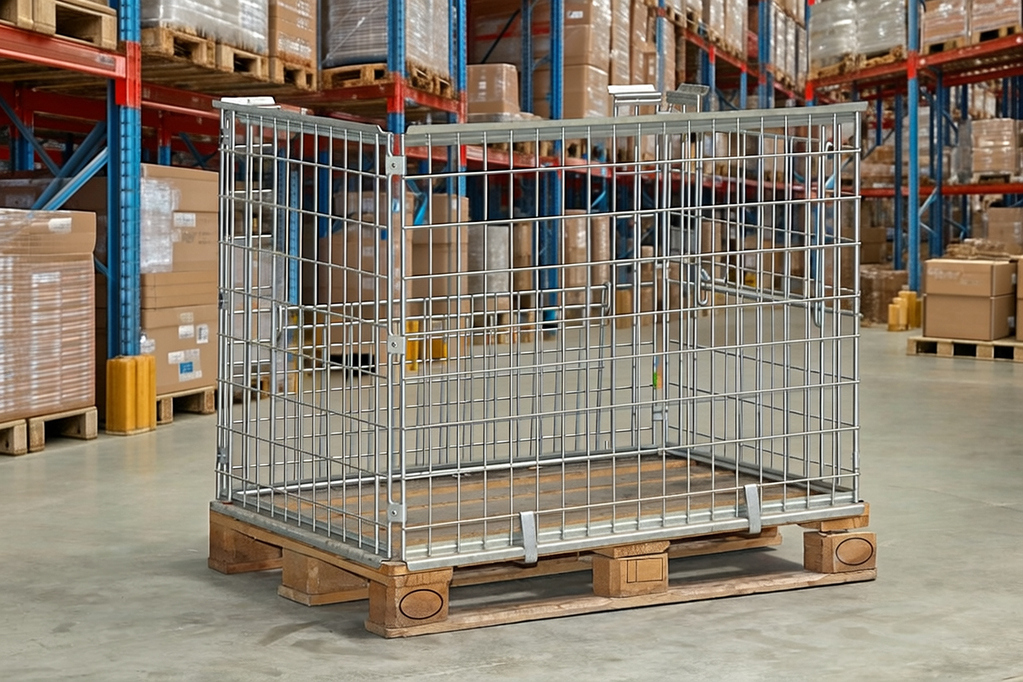
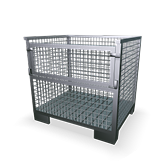
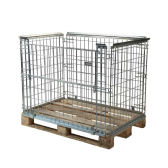
A retention unit is a collapsible wire mesh cage that fits onto a standard pallet, converting it into a secure, stackable container for loose, bulky, or irregularly shaped goods. Businesses use them in a multitude of situations such as tight warehouse space, seasonal demand peaks, and reducing single-use packaging consumption.
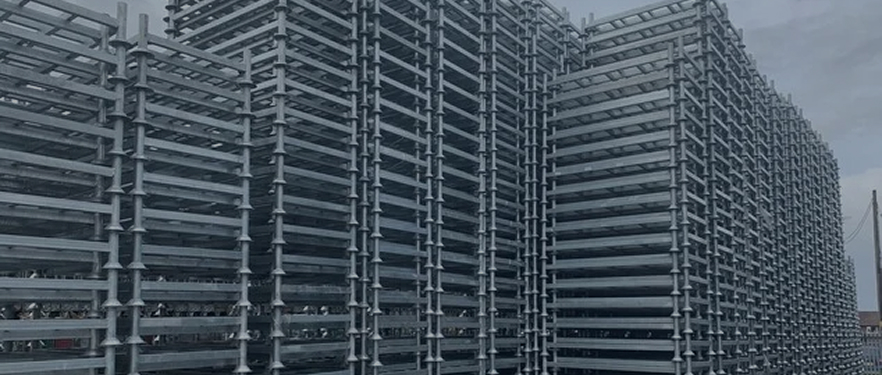
Retention units are commonly manufactured from galvanised steel and are designed to improve storage efficiency, product protection, and handling operations.
Retention units are often referred to as ‘pallet converter cages’, ‘pallet cage retention units’, or ‘pallet collars’; the latter being a lighter-duty and lower-capacity alternative.
What Is a Retention Unit?
A retention unit is a wire mesh frame that fits over a standard pallet, held in place with retaining clips rather than any permanent fixing. Businesses across different sectors rely on them to:
- Contain and secure loose or bulky goods.
- Improve storage efficiency.
- Enable stacking.
- Simplify handling and transportation.
- Protect products from damage.
Retention units are primarily classified into two main types known as stackable retention units and non-stackable retention units, with full or half-drop gates fitted to one or more sides.
They’re compatible with both timber pallets and plastic box pallets, giving you flexibility in how you build the right storage setup for you.
How Do Retention Units Work?
Retention units convert pallets into sturdy, practical, and high-capacity storage cages. The mesh frame drops neatly over the pallet and secures with retaining clips, meaning no tools or fixings are needed.
Once fitted, you get flexible access through full or half-drop gated, hinged or removable, positioned on one or more sides depending on how your team needs to load and unload stock.
When empty, the units fold flat for storage or return transport, cutting down on wasted space, whether it’s sitting in your warehouse or heading back down the supply chain.
It’s this combination – easy fitting, flexible access, and flat-folding when empty – that sets retention units apart from simpler options like plastic pallet collars.
Why Space and Load Stability Matter in Warehouse Storage
In warehouses where available footprint is a prized asset, storage methods that neglect vertical space or leave goods unstacked are both inconvenient and carry an ever-increasing, ongoing cost.
Without stackable storage:
- Valuable vertical warehouse space goes unused, reducing overall storage capacity.
- Uncontained goods are more likely to shift during handling, increasing damage and replacement costs.
- Poor stock visibility also slows handling and picking.
Retention units are the solution to these underlying problems warehouses face every day.
When Do You Need a Retention Unit?
Retention units solve genuine problems in a handful of common situations.
If, in your line of work, you’re handling loose, bulky, or irregularly shaped goods, a retention unit gives you a way to contain and move them easily as a singular standard pallet load. The structural build of retention units means they absorb the weight of other loads stacked on top, making them increasingly useful when your stock can’t safely support the extra weight alone.
They’re a practical means of making better use of vertical warehouse space too, converting single-layer pallet storage into stackable and freeing up free floorspace you’d otherwise lose. In high-traffic picking areas, the same containment protects both goods and staff from bumps, knocks, and falls during handling and moving.
Retention units also cut your reliance on single-use packaging. Swap repeated stretch wrap or shrink wrap for a reusable cage, and you’ll save on materials with every pallet run, particularly if you’re handling loose parts or components that would otherwise require individual boxing.
Their collapsible design also makes retention units ideal for seasonal demand and return logistics, as empty units fold flat for efficient transport and storage.
Retention units also work well for retail display or merchandising, keeping stock visible and accessible while still fully contained.
The Benefits of Using Retention Units
Retention units are a reusable, long-term investment in storage and handling efficiency. At Palletower, our retention units make a simple solution even smarter. We’ve transformed the humble pallet into a sturdy, high-capacity storage cage by adding extra clips and reinforced steel mesh, giving you a product that protects your stock and stacks up to four units high.
From cutting down on wasted floor space to reducing your reliance on single-use packaging, here’s what a well-chosen retention unit can do for your warehouse.
Space Efficiency
Load your units and stack them high. Empty them and fold them flat. This combination maximises both your active storage and your dead storage space. Retention units offer a useful middle ground: they give your goods the load-bearing strength of fixed storage, like static shelving or racking, without permanently taking up that footprint. For businesses whose storage needs shift throughout the year, that’s a genuine advantage over both loose stacking and fixed installations.
They’re also ideal as a returnable packaging solution, minimising space while in transit and ultimately cutting your transport costs.
Safety
A rigid, enclosed container reduces the risk of unstable stacking or falling stock. That means less risk of injury to your staff during handling. It also works in your favour on the business side too: fewer accidents from unstable stacking can mean lower injury-related costs and reduced risk exposure, as well as a safer working environment.
Stock Visibility and Control
Mesh sides allow your team to visually check and count stock without needing to unwrap or open packaging. That speeds up routine inventory checks and cuts the handling time spent opening, checking and re-securing goods, which matters most if you’re checking stock frequently in a high-turnover environment. Better visibility also aids in flagging damaged or incorrect stock earlier, before it moves further down your supply chain
Cost Savings Over Time
Retention units are a reusable alternative to single-use packaging like stretch wrap. The investment pays back through repeated use as opposed to ongoing consumable spend. If you’re rewrapping every pallet run, you’re paying a recurring cost that a reusable unit removes after the initial purchase. The more frequently your business handles loose or bulky goods, the faster this cost difference adds up, making retention units a stronger case the higher your handling frequency.
Versatility Across Sectors
- Automotive – containing and transporting loose components between production lines and suppliers, where irregularly shaped goods make standard pallet stacking impractical.
- Food distribution – moving and storing bulk or loose goods securely while keeping stock visible for checks and rotations.
- Retail, ecommerce, and retail supply chain – supporting high-volume, high-turnover storage where stock needs to be quickly accessed and replenished.
- Warehouse storage – converting single-layer pallet storage into stackable storage, freeing up floor space for other operations.
- Manufacturing – storing and moving components or finished goods in bulk between production and dispatch areas.
Stackable vs Non-Stackable Retention Units: Which Do You Need?
Generally speaking, automotive and manufacturing sites tend to lean toward stackable units due to moving high volumes of components and wanting to make the most of vertical space. Whereas food distribution and retail merchandising often favour non-stackable units. These industries tend to handle loose, delicate stock that shouldn’t carry the weight of another loaded cage on top, so visibility and easy access usually matter more than stacking height.
However, most warehouses don’t exclusively pick one or the other. Instead, they adopt a blend, typically using stackable units for their core bulk storage and non-stackable units for smaller or occasional loads.
The table below should help you to distinguish which retention unit is best suited to your warehouse.
How to Choose the Right Retention Unit for Your Business
With the benefits outlined, now it’s time for you to work out which retention unit is best suited to your operation. From pallet size to how often you’ll access your stock, a few key factors will help to steer you towards the right choice.
Pallet Size and Compatibility
Retention units are designed to fit standard Euro and UK pallets. At Palletower, we also offer a bespoke sizing service for non-standard pallets or unusual load shapes, so you get a unit that fits your fleet exactly rather than adapting your operation to a standard size.
Load and Stacking Requirements
Consider both your typical load and intended stacking height, as this will inform which retention unit you choose. Lightweight, uniform goods often suit stackable units to maximise vertical space, while loose or delicate products are generally better suited to non-stackable units. Heavier loads may require reinforced models.
The heavier your typical load and the higher you intend to stack, the more you’ll need a heavier-duty unit built to bear that weight. Lighter loads or single-level storage can usually be handled by a standard unit instead.
Access Requirements
It was noted earlier that retention units have two different gate types: full and half-drop. The suitable combination for your operation depends on how you intend to use the retention unit day to day.
A full drop gate suits teams that need to reach the entire unit at once, giving easier access than a half drop gate when stock is accessed frequently. A half-drop gate works well when access to the lower section is enough, for example, when picking from the base without disturbing stock above. If more than one person needs to reach the unit from different angles, for example, in a saturated picking area, gates on multiple sides help avoid a bottleneck and speed up handling.
Buy vs Rent
Whether you decide to rent or buy comes down to how consistently you’ll use a retention unit.
Buying makes sense if you require retention units on an ongoing basis and as a permanent part of your warehouse storage or handling process. It is a higher upfront cost, but you get full ownership and no return deadline to be conscious of.
Renting suits seasonal peaks, short-term projects, or trialling retention units before committing capital. It reduces upfront costs and gives you the flexibility to scale up for a busy period and return them when demand settles.
Palletower offers buying, renting, and leasing options, so you can choose the option best suited to how your warehouse operates.
Key Features of Palletower Retention Units
| Product | Base size mm | Total height mm | Internal height mm | Stackability | Weight kg | Gate config |
| Euro Pallet RU
|
800 x 1,200 | 1,000 | 850 | 4 high | 30 | Half-drop, 1 long side |
| RU 1,000mm Half-gate
|
1,000 x 1,200 | 1,000 | 850 | 4 high | 32.5 | Half-drop, 1 long side |
| RU Four gate access
|
1,000 x 1,200 | 1,000 | 850 | 3 high | 32.5 | Half-drop, all 4 side |
| RU 1,200mm Height
|
1,000 x 1,200 | 1,200 | 1,050 | 3 high | 37.5 | Half-drop, 1 long side |
| RU 1,450mm Height
|
1,000 x 1,200 | 1,450 | 1,300 | 2 high | 48.6 | Half-drop, 1 long side |
| Stackable RU 2-way access
|
Standard/ Euro | 1,110 | 932 | 4 high | 33 | Removable gates, both short sides |
All stackable retention units share a galvanised or bright zinc plate finish with heavy-duty mesh infill, and secure to the pallet using retaining clips rather than a permanent fixing. Each has a total maximum load capacity of 800kg.
The non-stackable range is more straightforward, with a single model covering different access needs:
| Product | Base size mm | Total height mm | Internal height mm | Stackability | Weight kg | Gate config | Finish |
| Non-stackable RU | 1,000 x 1,200 | 1,680 | 1,530 | 0 | 32 | 1 to 4 half-drop or full-side gates | Galvanised |
Because it’s not built to carry a loaded unit on top, the non-stackable model uses a simpler frame, which keeps the unit lighter and more cost-effective for single-level use.
All stackable and non-stackable units are fully collapsible, folding flat for storage or return transport when empty. For further information on a product’s mesh size and folded dimensions, please click the product name in the table.
Retention Units as Part of a Wider Strategy
Retention units work best when they’re utilised as part of a wider strategy, alongside other storage decisions, as opposed to working in isolation. For example:
- Racking and shelving – as retention units are commonly used within racking systems, the choice of racking system informs which retention units are best used and how they’re deployed.
- Pallet choice – since retention units fit onto existing pallets, the type of pallet used (timber or plastic) matters.
- Handling equipment – forklifts and pallet trucks need to be compatible with loaded, stacked retention units, particularly at maximum stack height.
Retention Units and Warehouse Storage Solutions from Palletower
Retention units help businesses maximise warehouse space, improve product protection, and reduce reliance on single-use packaging.
Palletower holds extensive UK stock with units ready for immediate dispatch. You can buy, rent, or lease to meet your operational needs, whether that’s permanency or a short-term solution for busy periods.
Browse our full range of retention units and wider storage solutions, and enquire or contact the Palletower team to talk through what would work best for your operation.